Direct answer: write the cap, the basis, the trigger, and the trim now
A documented position-sizing rule needs four sentences, and you should write all four before the holding gets any larger. First, the maximum weight you will allow for any single holding, plus a separate maximum for a correlated group such as employer stock held alongside an employer-heavy fund. Second, the basis on which that weight is measured. Third, the event that forces a review. Fourth, the procedure you will follow when a review says to trim.
The reason to write it early is not that the arithmetic changes later. It is that your willingness to apply the rule changes later. Once a holding carries a large embedded gain and a few years of being right, every breach invites a fresh argument, and the argument always arrives with the position at its largest. A number you chose while calm is the only version of the rule that was set without that pressure.
The purpose of the cap itself is worth stating in the document so the limit is not arbitrary. The SEC investor guide presents diversification and asset allocation as the tools that limit how much any single holding or category can determine the portfolio outcome, and presents rebalancing as the step that brings the portfolio back to its original intended mix after some holdings grow faster than others (SEC, Beginners’ Guide to Asset Allocation, Diversification, and Rebalancing: https://www.sec.gov/investor/pubs/assetallocation.htm). FINRA makes the same point in its investor basics material on asset allocation and diversification (FINRA, Asset Allocation and Diversification: https://www.finra.org/investors/investing/investing-basics/asset-allocation-diversification).
- Limit: a maximum percentage for one holding, and a second maximum for a correlated group you name explicitly.
- Basis: what the percentage is measured against, listed account by account.
- Trigger: a fixed review date, plus a breach margin that forces an off-calendar review.
- Procedure: how much you sell per review, in how many steps, using which order instruction.
- Record: the date you wrote the rule, the reason you chose that number, and where the document lives.
Fix the measurement basis so the limit cannot be argued with later
Most position limits are not broken by a decision to break them. They are quietly waived by an ambiguous denominator. If your rule says a single holding may not exceed a stated percentage, the first question in a breach is always the same: percentage of what?
Answer it once, in writing, and in enough detail that two people reading your document would compute the same number. State whether weight is measured on current market value. State which accounts are inside the denominator, including the taxable brokerage account, IRAs, and any employer plan. State whether cash counts, and whether awards that have been granted but not vested count at all.
Then state the tie-breakers that otherwise become improvisation. Does the limit apply per account or across the whole household portfolio? If the same company is held directly and also sits inside a fund you own, does the fund exposure count toward the group limit? There is no universally right answer here, which is exactly why the answer belongs in the document rather than in the moment.
A denominator you have not verified is a separate problem from a denominator you have not defined. If your weights are computed from a connected data feed, decide in your rule that the authoritative figures are the ones on the broker confirmations and account statements, and that a flagged breach is checked against the statement before any order is placed. Account protection does not fill this gap either, since SIPC describes protecting customers of its member brokerage firms when a member fails, with defined limits, and states that it does not protect against a decline in the value of your securities (SIPC, What SIPC Protects: https://www.sipc.org/for-investors/what-sipc-protects).
- Name the valuation basis and the accounts included, and list the accounts you track but deliberately exclude.
- Decide whether cash, unvested awards, and fund-level exposure to the same company count toward the limit.
- Write that pending and unsettled items are handled one stated way, so weights do not jump between data refreshes.
- Reconcile positions, share counts, cash, and per-lot basis against the statement on a recurring schedule, and keep a short log of what mismatched and how it resolved.
- If an in-flight transfer is part of the picture, read the process directly rather than guessing at timing (FINRA, Account Transfers: https://www.finra.org/investors/investing/working-with-investment-professional/account-transfers).
Make the review trigger both calendar and threshold based
A limit with no trigger becomes a number you notice. Use two triggers so neither failure mode dominates. A fixed review date means the rule gets looked at even in a quiet market. A breach margin means a fast move does not wait months for the calendar to catch up.
Write the breach margin as a stated band around the limit rather than as a feeling. The practical version reads like this: review on the scheduled date, and also review within a stated number of days whenever the holding exceeds the limit by more than the stated margin. The margin exists so ordinary daily drift does not generate a review every week, which is how review fatigue starts.
Record who or what performs the check, and accept its boundary. Connected account data can surface a breach continuously, but it does not decide anything, and a dashboard notification is not a review. The review is the moment you open the document, confirm the measured weight against the statement, and either act or write down why you did not.
- Calendar leg: the fixed dates when the limit is checked regardless of market conditions.
- Threshold leg: the margin above the limit that forces an off-calendar review, and the deadline for holding it.
- Distinguish a breach caused by appreciation, which can wait for the stated deadline, from one caused by a new purchase, which the rule should block at entry.
- State explicitly that a flagged breach is verified against the broker statement before an order is entered.
Pre-specify the trim procedure and the order instruction
The trim is where a documented policy most often turns back into a judgment call. If the rule only says reduce to the limit, you still have to decide how much, over how long, and with what order, while looking at a live quote on the day a position is moving. Decide those in advance and the execution step becomes mechanical.
Write the amount per review, the number of tranches, the interval between them, and the condition that pauses the plan. Then log each executed tranche against the plan, so a partially completed trim is visible at the next review instead of being remembered as finished.
Specify the order instruction in the policy, not at the terminal, and make sure the instruction matches what your broker will actually accept. SEC investor education explains that a market order is an order to buy or sell immediately that guarantees execution but not the execution price, and that a limit order executes only at the limit price or better, so it may not execute at all (SEC Investor.gov, Types of Orders: https://www.investor.gov/introduction-investing/investing-basics/how-stock-markets-work/types-orders). Choosing between those is choosing which failure you accept on a fast day, and the choice belongs in the document.
If any account in scope uses margin, note that firm requirements operate at the same time as your cap and can force action on the firm’s schedule rather than yours, so read the collected requirements and your own margin agreement before you rely on a staged plan (FINRA, Margin Accounts: https://www.finra.org/rules-guidance/key-topics/margin-accounts).
- Amount and staging: the quantity per review, the number of tranches, and the interval between them.
- Instruction: the default order type, whether a limit is used, and how far from the prevailing price.
- Fallback: what happens when an order does not fill, written before the order is placed (SEC Investor.gov, Types of Orders: https://www.investor.gov/introduction-investing/investing-basics/how-stock-markets-work/types-orders).
- Pause condition: the stated event that suspends the staging plan until the next review.
Run the tax checklist before the trim, not at filing time
A trim in a taxable account has consequences beyond your allocation, so the review order matters. Write the portfolio reason for the trade first, then the tax consequence, so a tax outcome never becomes the only justification for changing a position size.
The checklist itself is short and repeatable. Identify the specific tax lots and their acquisition dates, since IRS guidance explains that the holding period determines whether a capital gain or loss is short-term or long-term (IRS Topic 409, Capital Gains and Losses: https://www.irs.gov/taxtopics/tc409). State your lot-identification method in writing, confirm whether your broker’s default matches it, and document how and when a specific-lot instruction must be given relative to the trade.
If any part of the plan involves a loss sale, add the wash sale check on both sides of the trade date and across every account you control, including retirement accounts your broker does not report together, because the rule can disallow a loss when substantially identical stock or securities are acquired within the surrounding window (IRS Publication 550, Investment Income and Expenses: https://www.irs.gov/publications/p550). Automatic plans such as dividend reinvestment and recurring buys place purchases too, so they belong in the scan.
Keep the checklist as process design and send the specifics elsewhere. Read the primary material directly, both the IRS page on how capital gains and losses are treated (IRS Topic 409, Capital Gains and Losses: https://www.irs.gov/taxtopics/tc409) and the IRS guidance on investment income and expenses that covers wash sales (IRS Publication 550, Investment Income and Expenses: https://www.irs.gov/publications/p550), then confirm the treatment of your own facts with a qualified tax professional before the sale rather than at filing time.
- List the lots in scope with acquisition dates and short-term or long-term status (IRS Topic 409: https://www.irs.gov/taxtopics/tc409).
- Write your lot-identification method and the step that delivers the instruction to the broker.
- For any loss sale, scan the window on both sides of the trade date across all accounts you control (IRS Publication 550: https://www.irs.gov/publications/p550).
- Record the portfolio reason above the tax reason in the trade note, in that order.
Add an eligibility gate for compensation-derived shares
For many self-directed investors the concentrated position came from equity compensation, which means a weight-based trim is not purely a portfolio decision. Before the order exists, the policy should require a check of what the shares actually are.
Make that gate explicit: confirm whether the shares are restricted or control securities, whether you are treated as an affiliate, and which resale conditions apply, using the SEC’s own description of the conditions that must be met before restricted or control securities can be sold in the public market (SEC Investor.gov, Rule 144: Selling Restricted and Control Securities: https://www.investor.gov/introduction-investing/investing-basics/glossary/rule-144-selling-restricted-and-control-securities). Confirm your particular facts with your plan administrator or your own counsel before you rely on the answer.
Record employer-specific constraints separately from securities-law constraints, because they are different gates and either one can block a trim. Trading windows, pre-clearance requirements, and plan-level rules can bind even when a resale condition is satisfied, and a staged trim that ignores a window will stall halfway through.
- Share status: restricted, control, or unrestricted, confirmed per lot rather than per position.
- Affiliate status and the resale conditions that follow from it (SEC Investor.gov, Rule 144: https://www.investor.gov/introduction-investing/investing-basics/glossary/rule-144-selling-restricted-and-control-securities).
- Employer constraints: trading windows, pre-clearance steps, and who approves them.
- A stated outcome when the gate is unresolved, which should be a delay rather than a smaller trade.
Record exceptions as amendments, not as silence
You will eventually decide to hold above your limit. That is allowed, and it does not have to destroy the policy, but it has to be written. Record the reason you are holding above the limit, the new limit you are adopting, the date, and the date you will revisit the decision.
The distinction is simple and it is the whole discipline. An amended policy is still a policy, because the next reviewer, including you in a year, can see what changed and why. An ignored policy stops being one the first time a breach passes without a note, and after that the document only describes what you used to intend.
Keep an eye on the pattern rather than the single exception. If every breach produces an amendment, the original limit was not one you believe, and the honest fix is to rewrite the limit deliberately on a scheduled date instead of raising it under pressure each time the position grows.
- Amendment entry: old limit, new limit, reason, date, and the scheduled revisit date.
- Review the accumulated amendments on a fixed date, separate from any live breach.
- If amendments outnumber trims, rewrite the limit rather than continuing to waive it.
Keep a review log you will actually reopen
The document earns its value at the second review, when you want to know whether the rule worked rather than whether you felt good about the trade. That requires keeping the inputs at the time, including the reviews where you looked and correctly did nothing.
Keep it mechanical: the date, the rule version in force, the measured weight and the denominator used, which trigger fired, whether the statement confirmed the breach, the tax and eligibility checks and their answers, the order instruction, and the fill or the reason there was none. Note any tranche left outstanding so the next review starts from the real state of the plan.
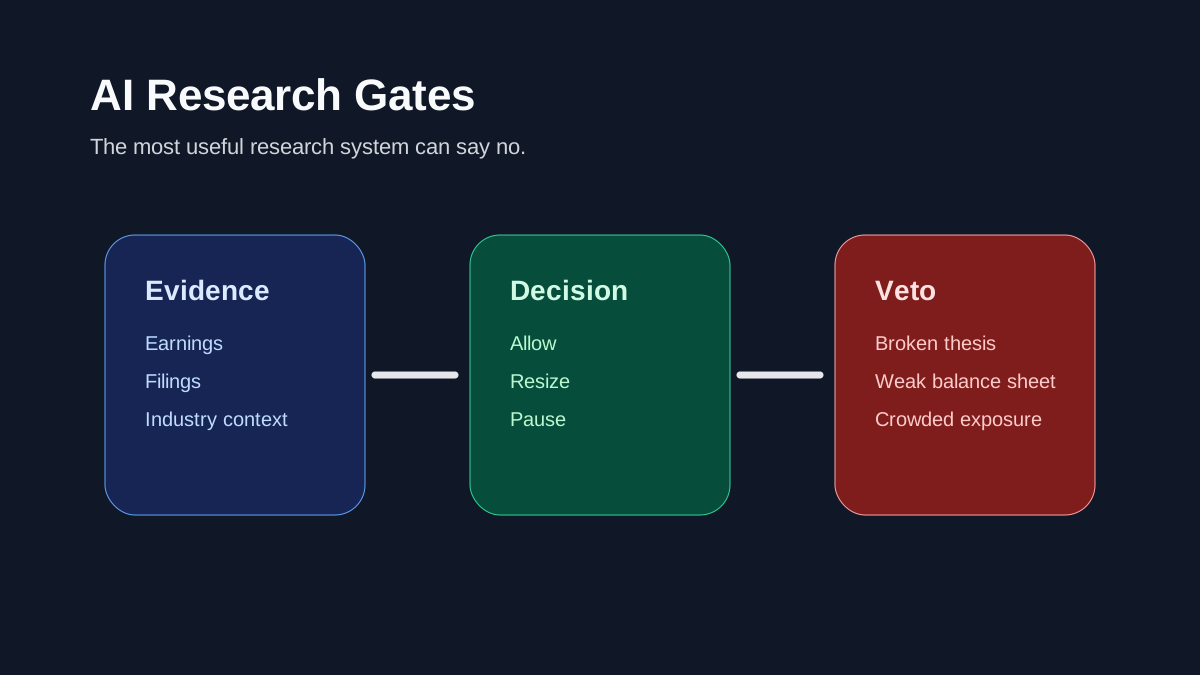
This is the same structure Investory uses elsewhere: the rule proposes an action, the gates decide whether it proceeds, and the record shows what happened either way. Review the logs on a fixed date rather than during a breach, since a policy edited in the middle of a decision tends to end up agreeing with the decision.
- Date, rule version, measured weight, and the denominator used to compute it.
- Trigger that fired, and whether the broker statement confirmed the breach.
- Tax and eligibility gate answers, with the lots identified.
- Order instruction, quantity, fill, and any tranche still outstanding.
- Next scheduled date to review the limit itself.