Direct answer: pick the instruction that matches the failure you accept
A rule that says "exit when the position breaks my risk level" is only half an instruction. The other half is which order type expresses it, how long the order lives, and what happens if it does not fill. On a volatile day those details decide your outcome more than the level itself.
The choice reduces to one trade-off. SEC Investor.gov explains that a market order is an order to buy or sell at the best available current price and does not guarantee a price, while a limit order sets the price at which you are willing to trade and may not be executed (SEC Investor.gov, Types of Orders: https://www.investor.gov/introduction-investing/investing-basics/how-stock-markets-work/types-orders). You cannot have both certainties at once, so decide in advance which one your exit rule needs.
If your rule exists to cap how much a position can hurt the portfolio, execution certainty is usually the point, and price uncertainty is the cost you accept. If your rule exists to harvest a target price, price control is the point, and not trading at all is the cost you accept.
- Condition: the observable event that triggers action, written so two readers agree it happened.
- Instruction: order type, price if any, quantity, and time-in-force.
- Placement: resting in advance, or entered manually after you look at the quote.
- Accepted failure: price uncertainty or non-execution, stated per position.
What each order type actually does when quotes move fast
Keep the mechanics literal. SEC investor education describes a stop order as an order that becomes a market order once the stop price is reached, and a stop-limit order as one that becomes a limit order once the stop price is reached, which is why a stop-limit can go unfilled if the market moves past your limit (SEC Investor Bulletin, Stop, Stop-Limit, and Trailing Stop Orders: https://www.investor.gov/introduction-investing/general-resources/news-alerts/alerts-bulletins/investor-bulletins-15).
That single distinction explains most surprise outcomes. The SEC is explicit that the stop price is not the guaranteed execution price: it is a trigger that turns the order into a market order, and the execution price can deviate significantly from the stop price depending on the liquidity available when it executes, while a stop-limit order may not execute at all if the price moves away from your limit, leaving you holding the position you intended to exit (SEC Investor Bulletin, Stop, Stop-Limit, and Trailing Stop Orders: https://www.investor.gov/introduction-investing/general-resources/news-alerts/alerts-bulletins/investor-bulletins-15).
FINRA investor education on stocks is a useful plain-language companion when you are deciding how much order complexity you want in a written rule (FINRA, Stocks: https://www.finra.org/investors/investing/investment-products/stocks).
- Market order: prioritizes execution, no price guarantee (SEC Investor.gov, Types of Orders: https://www.investor.gov/introduction-investing/investing-basics/how-stock-markets-work/types-orders).
- Limit order: prioritizes price, no execution guarantee (SEC Investor.gov, Types of Orders: https://www.investor.gov/introduction-investing/investing-basics/how-stock-markets-work/types-orders).
- Stop order: the stop price triggers a market order, and is not the guaranteed execution price (SEC Investor Bulletin, Stop, Stop-Limit, and Trailing Stop Orders: https://www.investor.gov/introduction-investing/general-resources/news-alerts/alerts-bulletins/investor-bulletins-15).
- Stop-limit order: becomes a limit order at the stop price, so it may not fill (SEC Investor Bulletin, Stop, Stop-Limit, and Trailing Stop Orders: https://www.investor.gov/introduction-investing/general-resources/news-alerts/alerts-bulletins/investor-bulletins-15).
Resting orders versus manual entry after review
Two investors with the same exit level can run it very differently. One leaves a resting stop in the market so the rule acts without them. The other watches for the condition and enters the order manually after reading the quote. Both are defensible, and each has a distinct weakness.
A resting order removes hesitation and works when you are away from the screen, at the cost of firing on a brief move you would not have acted on. Manual entry gives you the chance to check the spread and the size, at the cost of requiring you to be present and disciplined at the worst moment.
Write which mode each position uses and why. A thinly traded holding with a wide spread is a different problem from a large broad-market fund, and the same instruction does not have to apply to both.
- Resting: state the time-in-force, and cancel or refresh stale orders at each review.
- Manual: state what you are allowed to check, and a deadline so review does not become delay.
- Either way, confirm your firm documentation on order handling outside regular trading hours and around halts (FINRA, Stocks: https://www.finra.org/investors/investing/investment-products/stocks).
- Name who is authorized to place the order if more than one person has access (SEC Investor.gov, How to Avoid Fraud: https://www.investor.gov/protect-your-investments/fraud/how-avoid-fraud).
Write the fallback before the rule needs it
The most common gap in a rules-based exit is silence about non-execution. If a stop-limit does not fill, the rule has to say what happens next, because doing nothing is itself a decision and it usually gets made under pressure.
Pick one escalation path and put a time or price boundary on it. Options include converting to a market order after a stated point, widening the limit by a stated amount once, trimming part of the position instead of all of it, or standing down until the next session and reviewing.
Also decide how the exit interacts with your other rules. If a drift-driven rebalance would buy the same holding your risk rule is selling, one of them has to yield, and rebalancing is defined as returning a portfolio to its intended allocation rather than as a market call (SEC Investor.gov, Rebalancing: https://www.investor.gov/introduction-investing/investing-basics/glossary/rebalancing).
- Trigger point for escalation: a time, a price, or the close of the session.
- Allowed escalation actions, listed in order, with one attempt each.
- Stand-down clause: what you hold and what you review if nothing fills.
- Conflict clause: which rule yields when an exit and a rebalance fire together.
Check the tax inputs before the order goes in
Exits fire faster than tax review, so move the review upstream into order entry. IRS guidance on capital gains and losses explains that the holding period determines whether a gain or loss is short-term or long-term (IRS Topic 409, Capital Gains and Losses: https://www.irs.gov/taxtopics/tc409), which means lot-level holding status is a pre-trade field, not a year-end discovery.
If your rule allows re-entry after a loss sale, read the wash sale discussion, which covers selling stock or securities at a loss and acquiring substantially identical stock or securities within the applicable window (IRS Publication 550, Investment Income and Expenses: https://www.irs.gov/publications/p550). Scheduled buys and dividend reinvestment in other accounts you control are easy to forget when the exit is urgent.
This is process design, not tax advice. Specifics depend on your facts, so route unresolved basis, lot, or re-entry questions to a qualified tax professional instead of forcing the order through.
- Record the lots you intend to sell and confirm how your firm documents lot identification.
- Note short-term or long-term status per lot before entry, since the holding period sets that character (IRS Topic 409: https://www.irs.gov/taxtopics/tc409).
- Flag any planned replacement purchase for the substantially identical question (IRS Publication 550: https://www.irs.gov/publications/p550).
- Reconcile your trade log against broker tax forms when they arrive rather than editing your records to match.
Make sure the account data behind the order is trustworthy
Order type is the last step. The quantity comes from your sizing rule, and that rule reads account values that can shift with settlement timing, pending orders, and borrowed funds. Define the denominator explicitly: settled cash, total account value, or equity net of borrowed funds.
If the account borrows, the margin requirements that apply to member firm accounts are set out in FINRA Rule 4210 (https://www.finra.org/rules-guidance/rulebooks/finra-rules/4210), so buying power and maintenance levels can change your effective position size without any action from you. Read your firm margin agreement alongside that rule.
Keep custody protection separate from market risk in your policy language. SIPC explains what customer protection covers and what it does not (SIPC, What SIPC Protects: https://www.sipc.org/for-investors/what-sipc-protects), and no order type addresses either one on its own.
- Reconcile brokerage-connected data against the firm statement on a fixed schedule.
- Treat unexplained differences as a stop on new rule-driven orders until resolved.
- State the denominator in your sizing rule and confirm your data reports that figure.
- Review which applications have account access and use the strongest authentication your firm offers (SEC Investor.gov, How to Avoid Fraud: https://www.investor.gov/protect-your-investments/fraud/how-avoid-fraud).
Log the exit so the rule can be judged on results
An exit rule is only reviewable if you keep the inputs. Record the intended level, the instruction you used, and what actually happened, including the times the condition triggered and you chose not to act.
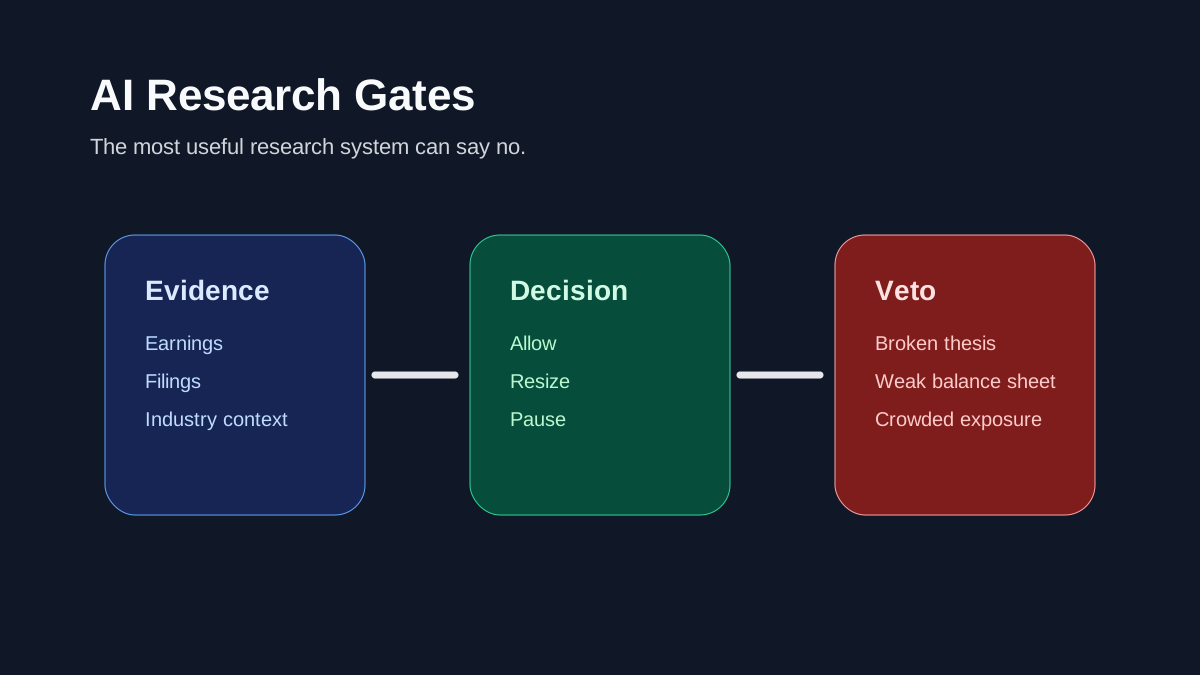
Review the pattern on a fixed date rather than in the middle of a fast market. If stop-limits keep going unfilled, the rule is telling you it wants execution certainty. If market-order fills keep landing far from your level, the rule is telling you to size smaller or stage the exit. This is the same structure Investory uses elsewhere: the rule proposes the action, the gates decide whether it proceeds, and the receipt records the outcome either way.
- Date and time of the trigger, and the level the rule specified.
- Order type, price if any, time-in-force, and whether it was resting or manual.
- Fill price and quantity, or the reason for non-execution and the fallback taken.
- Lots sold and holding period status captured before entry.
- The rule version in force, and the next scheduled date to review the rule itself.