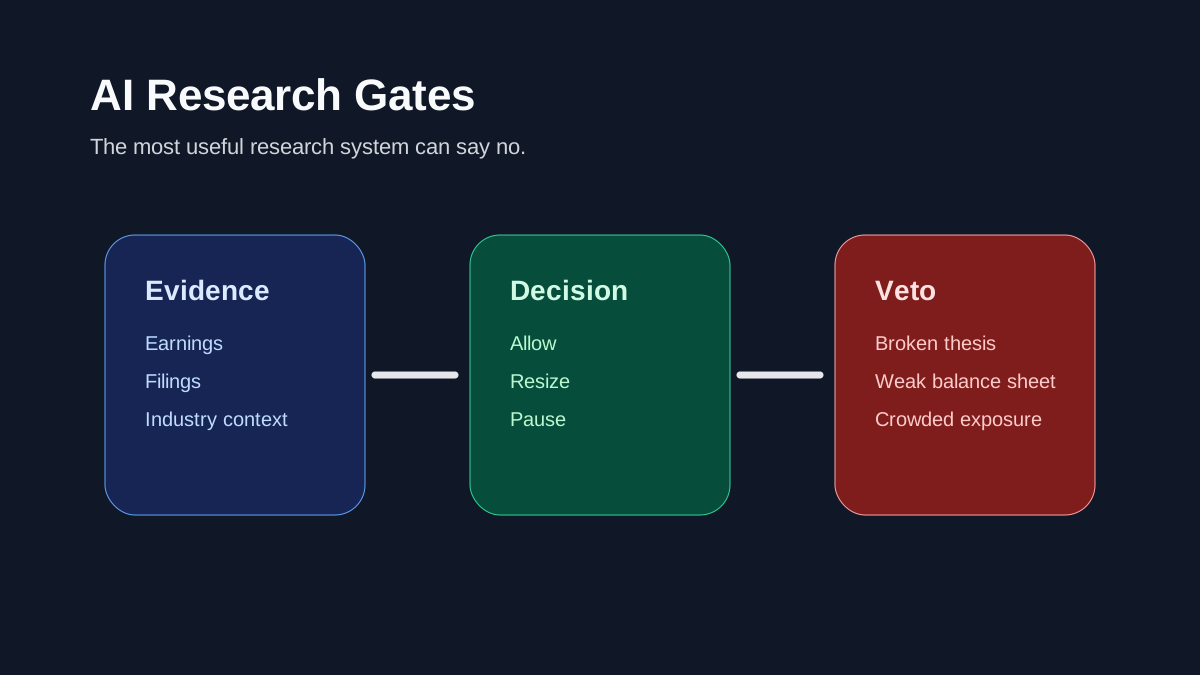
Direct answer: give the AI step a veto, never the order ticket
The split that works is narrow. AI is allowed to stop or delay a trade, and that is the whole of its authority. It can summarize a document you supply, restate the rules you already wrote, and tell you which condition looks unmet. It cannot size the position, pick the order type, submit the order, or settle a question by asserting a fact.
That asymmetry is deliberate because a flag is cheap and an order is not. If the gate raises an objection you cannot confirm in a filing, an issuer document, or your own brokerage statement, the trade waits. If the gate passes every condition, you still choose the quantity, the order instruction, and the moment of entry yourself, so there is no path from model output straight to execution.
Written this way, the AI step behaves like the research gate in any rules-based workflow: the rule proposes an action, the gate can block or delay it, and the record shows what happened either way. The difference from a human research check is only that the gate has no standing to be believed, so every flag it raises ends at a primary document rather than at its own explanation.
- Allowed: summarizing a document you provide, extracting the sections you point to, restating your rule set, and naming which conditions appear unmet.
- Allowed: generating the strongest counterargument to your own thesis so you have to answer it before buying.
- Not allowed: choosing position size, order type, limit price, time in force, or lots.
- Not allowed: resolving its own flag, supplying a number you cannot locate in a source document, or acting as the reason for the trade in your log.
Why AI output belongs on the research side of the line
Two regulator messages set the frame. SEC investor education warns that interest in AI is being exploited by fraudsters, including claims that an AI system can pick winning investments or produce guaranteed returns, and advises checking registration before moving money (SEC Office of Investor Education and Advocacy, Artificial Intelligence (AI) and Investment Fraud: https://www.sec.gov/oiea/investor-alerts-and-bulletins/artificial-intelligence-ai-and-investment-fraud-investor-alert). Any AI-sourced tip that arrives with a promise attached is a fraud signal, not a research input.
From the other direction, FINRA Regulatory Notice 24-09 reminds member firms that existing rules, including supervision, recordkeeping, and communications obligations, continue to apply when the firm uses generative AI and large language models (FINRA Regulatory Notice 24-09: https://www.finra.org/rules-guidance/notices/24-09). Those obligations sit on firms, not on you as a self-directed investor, but the principle transfers cleanly: introducing a model does not retire the process that was supposed to make the decision reviewable.
The practical consequence is that AI output carries no duty to you, no accountability, and no record of its own reasoning unless you create one. So it gets the job a skeptical reviewer would get, which is to object, and it does not get the job an accountable decision-maker would get, which is to authorize.
Write the gate conditions before you open a research tool
A gate only works if the conditions exist in writing before the candidate appears. Otherwise the model output becomes the rule, because it is the only thing in front of you with a definite opinion.
Write each condition so it can be answered yes or no, and require the answer to point at a source you can open: a filing, an issuer document, an exchange or broker notice, or your own account data. Conditions answered with AI prose do not count as answered. Keeping the citation requirement inside the condition is what stops a confident summary from quietly replacing the underlying document.
Keep the list short enough that you actually run it. Five or six conditions you check every time beat a twenty-item checklist you skip when a position is moving.
- Thesis: what has to be true about the business or fund, and which document you read to confirm it is still true.
- Valuation band: the range in which you are willing to buy or add, stated before you look at the current quote.
- Position-size cap: the maximum weight or dollar amount for this holding, measured against a denominator you define.
- Cash floor: the balance you will not go below, using settled cash rather than buying power.
- Tax and lot status: which lots are involved and whether a loss sale or replacement purchase is in scope (IRS Publication 550, Investment Income and Expenses: https://www.irs.gov/publications/p550).
- Account constraints: margin versus cash, settlement timing, and any trading-frequency designation that applies (FINRA, Day Trading: https://www.finra.org/rules-guidance/key-topics/day-trading).
Assign bounded jobs, and check the ones that go wrong
The failure mode is not that AI is useless. It is that an open-ended prompt invites an answer that sounds like a decision. Bounding the job to a document you supplied keeps the output checkable, because you can hold the summary next to the source and see whether it is right.
Useful bounded jobs include condensing a filing section you name, pulling the risk factors or footnotes you point to, restating your written rules and flagging which conditions the proposed trade appears to violate, and arguing the other side of your thesis. Each of those produces something you can verify or dismiss in minutes.
Then verify before acting. Discard any number, date, or comparison you cannot locate in the filing, exchange notice, or brokerage statement it supposedly came from. A discarded claim is not a small correction; it tells you the flag it supported was never evidence, and the trade goes back to waiting until a real source answers the question.
- One document, one question, one answer you can check against the page you supplied.
- Ask for the location of each claim inside your document, then open that location yourself.
- Treat an unresolved flag as a delay, not as a smaller position or a partial trade.
- Treat a promise of outperformance or guaranteed returns as a reason to stop and check registration (SEC Office of Investor Education and Advocacy, Artificial Intelligence (AI) and Investment Fraud: https://www.sec.gov/oiea/investor-alerts-and-bulletins/artificial-intelligence-ai-and-investment-fraud-investor-alert).
Keep the research tool read-only so a gate cannot become a trader
If the tool that raises flags can also place orders, you no longer have a gate, you have an execution path with a summary attached. Inventory what each connected tool can actually do: read positions only, read transactions and basis, or initiate orders and transfers. Remove anything broader than the research job requires, and prefer broker-sanctioned token-based access with read-only scope over shared login credentials.
Scope and revocation are worth checking before you connect, not after. The Consumer Financial Protection Bureau final rule on Personal Financial Data Rights addresses how consumers authorize third parties to access covered financial account data and how that authorization can be withdrawn (CFPB, Required Rulemaking on Personal Financial Data Rights: https://www.consumerfinance.gov/rules-policy/final-rules/required-rulemaking-personal-financial-data-rights/). Find the revocation control in your brokerage security settings first, so you know the exit exists.
Keep the data question separate from the custody question in your own notes. SIPC describes protecting customers of its member brokerage firms when a member fails, with defined limits and exclusions, and states that it does not protect against a decline in the value of your securities (SIPC, What SIPC Protects: https://www.sipc.org/for-investors/what-sipc-protects). A smoother research integration changes neither market risk nor how your own credentials are handled.
- Write down each connected tool, its scope, the date granted, and how you revoke it.
- Turn on login and transaction alerts, and reconcile tool-displayed holdings and basis against official statements and confirmations before any rule-driven trade.
- Re-read what your account agreement says about third-party access and activity conducted through shared credentials.
- Set a recurring access review, and remove connections for tools you no longer use.
Run the tax and order checks against primary documents
Two areas punish secondhand summaries hardest, so route both to the source. On tax, IRS Publication 550 sets out how the wash sale rule operates, including the effect of acquiring substantially identical stock or securities within the defined window around a loss sale and the consequences for the disallowed loss and the basis of the replacement shares (IRS Publication 550, Investment Income and Expenses: https://www.irs.gov/publications/p550). What your broker reports is governed separately, including covered versus noncovered securities and broker-reported wash sale adjustments (IRS, Instructions for Form 1099-B: https://www.irs.gov/instructions/i1099b). Because broker reporting is account-level, it will not necessarily match a plan that spans several accounts, so confirm your own situation with a qualified tax professional.
On execution, get the mechanics from the source rather than from a paraphrase. SEC investor education explains the trade-offs among market, limit, stop, and stop-limit orders, including that a market order prioritizes execution over price, a limit order prioritizes price over execution, and a stop order becomes a market order once triggered so the fill can be far from the stop price (SEC Office of Investor Education and Advocacy, Trading Basics: https://www.sec.gov/files/trading-basics.pdf). Decide which failure you accept before the order goes in.
Account rules can also block a trade your gate just approved. FINRA describes pattern day trader designation and minimum equity requirements applying to margin accounts that meet the definition (FINRA, Day Trading: https://www.finra.org/rules-guidance/key-topics/day-trading), and margin account mechanics and requirements are covered separately (FINRA, Margin Accounts: https://www.finra.org/rules-guidance/key-topics/margin-accounts). Check those constraints before you size, since a blocked exit or delayed re-entry changes the sequence your rule assumed.
- Before a loss sale, list every account you or a spouse control that could buy the same or a substantially identical security, including retirement accounts and automatic reinvestment programs (IRS Publication 550: https://www.irs.gov/publications/p550).
- Identify the lots you intend to sell and make the identification through your broker process at the time of the trade, not after settlement.
- Check whether the position is covered or noncovered for basis reporting, since that determines what the broker reports and what you must substantiate (IRS, Instructions for Form 1099-B: https://www.irs.gov/instructions/i1099b).
- State the order type and price band in the rule, and confirm time in force and extended-hours settings explicitly (SEC, Trading Basics: https://www.sec.gov/files/trading-basics.pdf).
- Convert the size cap into a share count and a dollar maximum against current account equity rather than a stale figure from a research tool.
Log the gate so you can review the rule instead of your memory
The gate produces its value later, when you want to know whether your conditions were any good. That requires one page per trade, written at the time, including the trades you decided not to place. A gate with no record of its blocks cannot be evaluated, only trusted.
Keep it short and mechanical: the date, the rule version in force, each condition and the source you checked it against, the flags the AI step raised, how each was resolved or why the trade waited, and your stated reason for acting or standing down. Note the order instruction you chose and the fill you got, so drift between the plan and the execution shows up in the record rather than in a vague sense that things are not working.
Review the accumulated logs on a fixed date rather than during a live decision. If flags are constantly overridden, the condition is wrong or the rule is wrong, and one of them should be rewritten deliberately. If unverifiable AI claims keep appearing, narrow the job you assign. Either way, the decision, the sizing, and the order stayed with you, which is what makes the review possible at all.
- Date, rule version, and the candidate action the rule proposed.
- Each gate condition, the source consulted, and the answer.
- Flags raised, how each was verified or discarded, and the resulting delay.
- Your stated reason for acting or standing down, plus order type, quantity, and fill.
- Next scheduled date to review the conditions themselves.