Direct answer: calendar, threshold, or both
All three forms work. What does not work is leaving the choice unwritten, because then you rebalance when the portfolio feels off and the decision changes with your mood. Rebalancing means bringing your portfolio back toward your original mix when market movement has shifted the weights, and the SEC investor education material on asset allocation, diversification, and rebalancing describes it as a way to keep your risk level consistent with your plan rather than a way to increase return (SEC, Beginners’ Guide to Asset Allocation, Diversification, and Rebalancing: https://www.sec.gov/investor/pubs/assetallocation.htm).
A calendar rule reviews on fixed dates. A threshold rule reviews when a weight leaves its band. A combined rule checks on the calendar date and acts only if a band is breached, which caps how often you can trade while still requiring a stated reason to trade.
The combined form is a practical default for a written policy. Calendar-only can force a trade when nothing has meaningfully drifted, and threshold-only invites you to watch position data all day and act on small breaches. Choose based on how often you want to look and how much turnover you are willing to accept, then write the sentence down.
- Calendar-only: review on stated dates, trade whatever is off target on that date.
- Threshold-only: review on the day a sleeve weight moves outside its band, scheduled or not.
- Combined: review on the stated dates, and trade only the sleeves whose bands are breached.
Write the policy targets before the trigger
A trigger is meaningless without an unambiguous current weight to compare against. That means naming the source of truth before the rule fires, which matters more now that many investors hold several brokerage-connected accounts and see position data refreshed continuously.
Decide once whether cash counts as a sleeve, how unsettled balances are treated, and whether accounts you cannot trade in are included in the measurement. If two people reading your rule would compute different weights, the rule is not finished.
- List each sleeve or asset class with its target weight, and make the weights add up to the full portfolio.
- Name the accounts included in the measurement, and list held-away accounts you track but do not trade.
- State whether cash is a target sleeve or excluded from the denominator.
- State how often weights are measured and from which data source.
State the band form so the test is unambiguous
Drift bands come in two forms and they are not interchangeable. An absolute band adds or subtracts fixed percentage points from a target weight. A relative band multiplies the target weight by a stated percentage. The SEC investor guide describes using a predetermined change in asset-class weight as a rebalancing trigger (SEC, Asset Allocation and Rebalancing: https://www.sec.gov/investor/pubs/assetallocation.htm).
The difference matters most for small sleeves. A fixed point band can allow much more drift than a relative band when the target weight is small. Pick one convention, apply it consistently, and write the resulting upper and lower limits next to each target so the test needs no arithmetic at the moment of decision.
- Absolute band: target plus or minus a fixed number of percentage points.
- Relative band: target plus or minus a percentage of the target weight.
- Consider wider bands for small or thinly traded sleeves where spreads can be wide.
- Write the computed upper and lower limits, not just the band width.
Separate the trigger, the action, and the funding source
Most rebalancing rules fail because these three questions are blurred into one. The trigger says when you look. The action says how far you move. The funding source says where the money comes from.
Trading a breaching sleeve all the way back to target is the simplest action. Trading back only to the band edge moves a smaller amount and leaves the sleeve sitting at the edge of its band, so the same sleeve can breach again sooner. A stated partial move sits between the two. None of these is universally correct, so the point is to choose in advance rather than deciding while looking at a screen.
The funding decision often does more work than the trigger. If new contributions and cash distributions are directed to the underweight sleeve first, some breaches resolve without a sale, which keeps you out of the tax consequences that come with selling appreciated positions in a taxable account.
- Trigger: the exact date, band breach, or combination that starts a review.
- Action: back to target, back to the band edge, or a stated partial move.
- Funding: new cash and distributions first, then sales, in a stated account order.
- Single-sleeve breach: state whether you trade only that sleeve or rebalance everything.
Add the tax gate before you sell
Sales in a taxable account are the part of rebalancing that has consequences beyond your allocation. The character of a capital gain or loss depends on how long you held the asset, and IRS guidance on capital gains and losses explains that the holding period determines whether the result is short-term or long-term (IRS Topic 409, Capital Gains and Losses: https://www.irs.gov/taxtopics/tc409).
Lot selection belongs in the rule, not at the order screen. Confirm how your broker reports cost basis and what its default lot-selection method is, and specify lots before the order is entered rather than after settlement.
The cross-account trap is the wash sale: if you sell at a loss and substantially identical stock or securities are acquired within the applicable window, including by a spouse or a corporation you control, the loss may be disallowed (IRS Publication 550, Investment Income and Expenses: https://www.irs.gov/publications/p550). Scope the review across your accounts, a spouse’s relevant purchases, and applicable controlled entities; ask a qualified tax professional about complex ownership or basis questions.
Reconcile what the gate produced against the broker year-end tax forms rather than an in-app running estimate, and route anything the gate cannot resolve, such as complex basis or inherited lots, to a qualified tax professional instead of forcing the trade through.
- Prefer trades in tax-advantaged accounts where the same allocation change is available.
- Read holding periods per lot before selling, since character follows the holding period (IRS Topic 409: https://www.irs.gov/taxtopics/tc409).
- Run the wash sale check across your accounts, relevant spouse purchases, and applicable controlled entities, including scheduled buys and reinvestments (IRS Publication 550: https://www.irs.gov/publications/p550).
- Name in advance the non-substantially-identical exposure you would hold instead, and for how long.
Make the rule survive margin and position limits
If an account in scope uses margin, your concentration cap and the firm requirements operate at the same time, and they can point in opposite directions during a drawdown. Initial extensions of credit for securities purchases fall under Federal Reserve margin regulation, listed among the Board regulations including Regulation T (Federal Reserve Board, Regulations: https://www.federalreserve.gov/supervisionreg/reglisting.htm).
Maintenance requirements for FINRA member firms are set out in the rulebook, and firms are permitted to apply stricter house requirements than the stated minimums (FINRA Rule 4210, Margin Requirements: https://www.finra.org/rules-guidance/rulebooks/finra-rules/4210). Under a margin agreement, a firm may liquidate positions to meet a call, which means a sequence you did not choose can override your rebalancing plan.
The fix is to write the denominator and the response sequence in advance. A cap measured against total market value can be satisfied while equity is thin, so state whether limits are measured against market value, equity net of margin debt, or a single account, and decide now which positions are trimmed first if a call arrives.
- State the denominator used for each position and sleeve limit.
- Write a leverage ceiling separate from the concentration cap, regardless of what the account permits.
- Write the maintenance call response order and how it interacts with the tax gate (FINRA Rule 4210: https://www.finra.org/rules-guidance/rulebooks/finra-rules/4210).
- Distinguish appreciation-driven breaches, which can wait for the next review, from purchase-driven breaches, which the rule should block at entry.
Specify how the order is sent
Rebalancing policies usually say how much to trade and nothing about how the order goes out, which is where slippage and unfilled orders actually appear. SEC investor education on trade execution explains the basic trade-off: a market order emphasizes speed of execution, while a limit order sets a price constraint and may not execute at all (SEC, Trade Execution: What Every Investor Should Know: https://www.sec.gov/investor/pubs/tradexec.htm).
Your broker has an execution obligation, and it is a duty of diligence rather than a promised price. FINRA Rule 5310 requires a member firm to use reasonable diligence to ascertain the most favorable market for the stock or fund it is trading for you, and to obtain a price as favorable as possible under prevailing market conditions (FINRA Rule 5310: https://www.finra.org/rules-guidance/rulebooks/finra-rules/5310). Keep that separate from account protection. SIPC materials state that SIPC protection applies to the failure of a member brokerage firm and the custody of the cash and securities it held for you, rather than to market losses (SIPC, What SIPC Protects: https://www.sipc.org/for-investors/what-sipc-protects).
- Set a default order type and the exception, including a stated limit offset (SEC, Trade Execution: https://www.sec.gov/investor/pubs/tradexec.htm).
- Set a maximum acceptable spread, and whether to split larger orders rather than send them at once.
- Add a halt and volatility clause: review pending orders instead of leaving them standing.
- Cancel stale good-till-cancelled orders at each review rather than letting them sit.
Log the events and review the rule on a schedule
A rebalancing rule can only be evaluated later if you kept the inputs. Record each trigger event, including the ones where you looked and correctly did nothing, because the no-trade record is what tells you whether your bands are too tight or too wide.
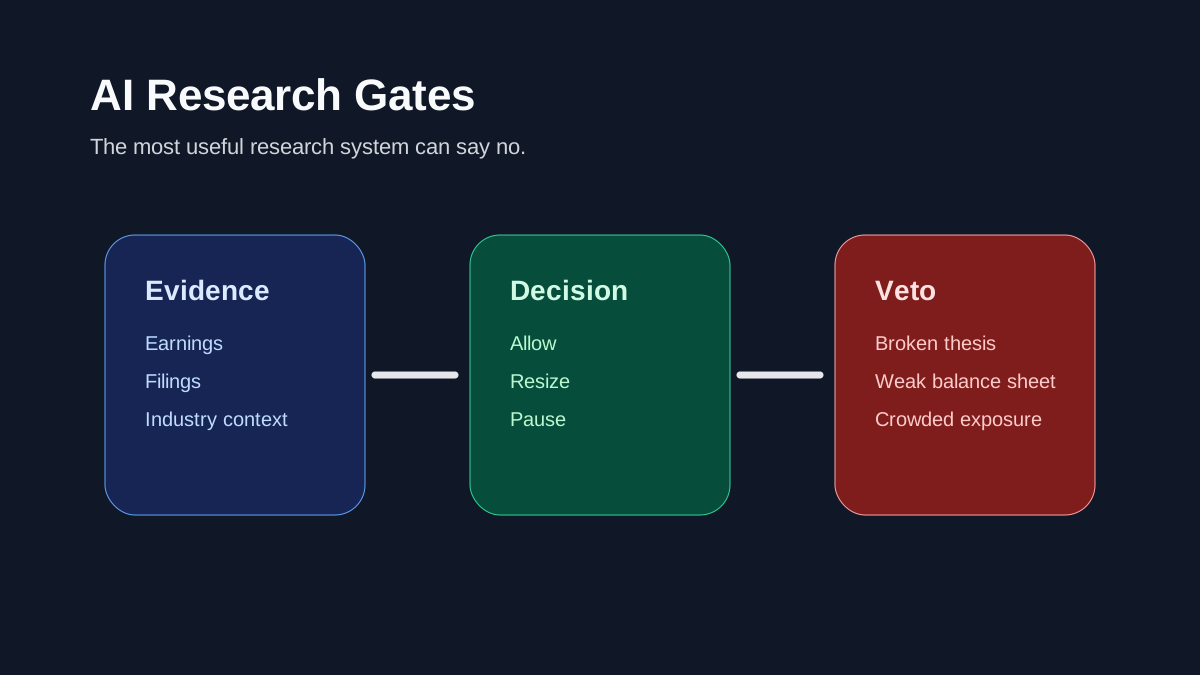
Set a fixed date to review the rule itself, separate from the dates the rule fires. Editing bands during a breach is how a policy quietly becomes whatever you wanted to do that day. This is the same pattern used elsewhere in Investory: the rule proposes an action, the research and risk gates decide whether it proceeds, and the receipt records what happened either way.
- Date of the trigger, the measured weights, and which bands were breached.
- Whether you acted, the funding source used, and the lots sold.
- Order type, spread, and fill, plus deviations from the written control.
- Realized gain or loss character, and disallowed losses identified by the check.
- The rule version in force, and the next scheduled date to review the rule.